【SPEECH】The Art of Persuasive Speaking : Insights from Dr. Jean Chow
Written by Chelsea Kendra Lemmuela
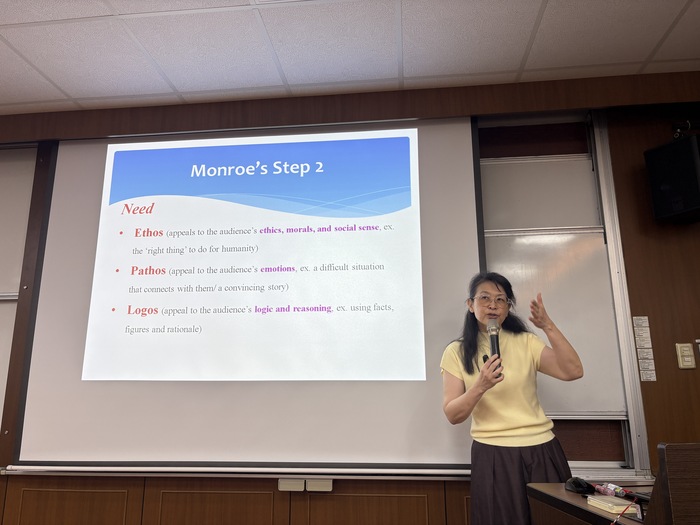
On September 29, IBBA students at National Sun Yat-sen University had the opportunity to attend an insightful guest lecture by Dr. Jean Chow, an experienced educator and communication specialist. Through her lectures, How to Hook the Audience and How to Visualize to Persuade, Dr. Chow introduced practical strategies for making persuasive speeches more engaging, memorable, and impactful. The sessions explored how speakers can capture attention, connect with their audiences, and inspire meaningful action through effective communication. In her session, How to Hook the Audience, Dr. Chow emphasized that the opening moments of a speech play a crucial role in determining whether an audience will continue listening. A strong message may lose its impact if the speaker fails to capture attention from the beginning. To address this challenge, she introduced several techniques for creating compelling openings, including humor, surprising statistics, personal stories, and rhetorical questions. These approaches encourage listeners to become curious, recognize their own experiences in the message, and remain engaged with the speaker. Beyond attracting attention, Dr. Chow also explained the importance of establishing a speaker’s authority. By introducing relevant personal experiences, backgrounds, and perspectives, speakers can build credibility and help audiences understand why their message deserves consideration.
Dr. Chow further connected these techniques to Monroe’s Motivated Sequence, a five-step framework for organizing persuasive speeches: Attention, Need, Satisfaction, Visualization, and Action. This framework demonstrates that persuasion is a structured process rather than simply an attempt to convince others through words. Speakers must first gain attention, establish the importance of an issue, propose a solution, illustrate its potential outcomes, and ultimately encourage the audience to take action. Through examples of well-known speeches and practical speaking exercises, students explored how these principles can be applied to different topics and real-world situations. Building on the importance of capturing attention, the session How to Visualize to Persuade focused on the power of helping audiences imagine the consequences of a decision. As the fourth step of Monroe’s Motivated Sequence, visualization allows speakers to strengthen their message by illustrating what the future might look like if a proposed solution is adopted—or if the problem remains unresolved. Dr. Chow introduced three approaches to visualization: the positive method, which emphasizes desirable outcomes; the negative method, which highlights the potential consequences of inaction; and the contrast method, which compares both possibilities. By presenting these different scenarios, speakers can help audiences recognize the significance of their choices and develop a stronger connection to the proposed solution. To make visualization more effective, Dr. Chow also highlighted the importance of descriptive language. Techniques such as imagery, similes, metaphors, and personification can transform abstract ideas into vivid and relatable experiences. Rather than merely telling an audience that a situation is important, speakers can use sensory details and carefully chosen comparisons to help listeners imagine what it would look, sound, or feel like. These techniques make a message easier to understand and remember while creating an emotional connection between the speaker and the audience. Through practical examples and exercises, students were encouraged to think beyond factual explanations and consider how language can bring their ideas to life.
Throughout the sessions, Dr. Chow also emphasized the ethical responsibility that comes with persuasive communication. Because persuasive messages can influence people's beliefs, decisions, and behavior, speakers must consider not only how effectively they communicate but also the purpose behind their message. She encouraged reflection on whether a message is truthful, promotes positive change, and considers the well-being of the audience and the wider community. Persuasion, therefore, should not be used to manipulate others, but to communicate ideas responsibly and encourage informed decision-making. Dr. Jean Chow’s guest lecture provided IBBA students with valuable insights into the art and structure of persuasive speaking. By combining practical techniques for capturing attention with strategies for visualizing future outcomes, the sessions demonstrated how effective communication can move beyond the delivery of information to inspire understanding and action. The IBBA program sincerely thanks Dr. Jean Chow for sharing her knowledge and expertise. Her lecture equipped students with practical skills that can be applied in academic presentations, professional settings, and everyday interactions, empowering them to become more confident, thoughtful, and persuasive communicators.