《112-2_IB528》Economic Development in the Philippines
Written by Minh Trinh
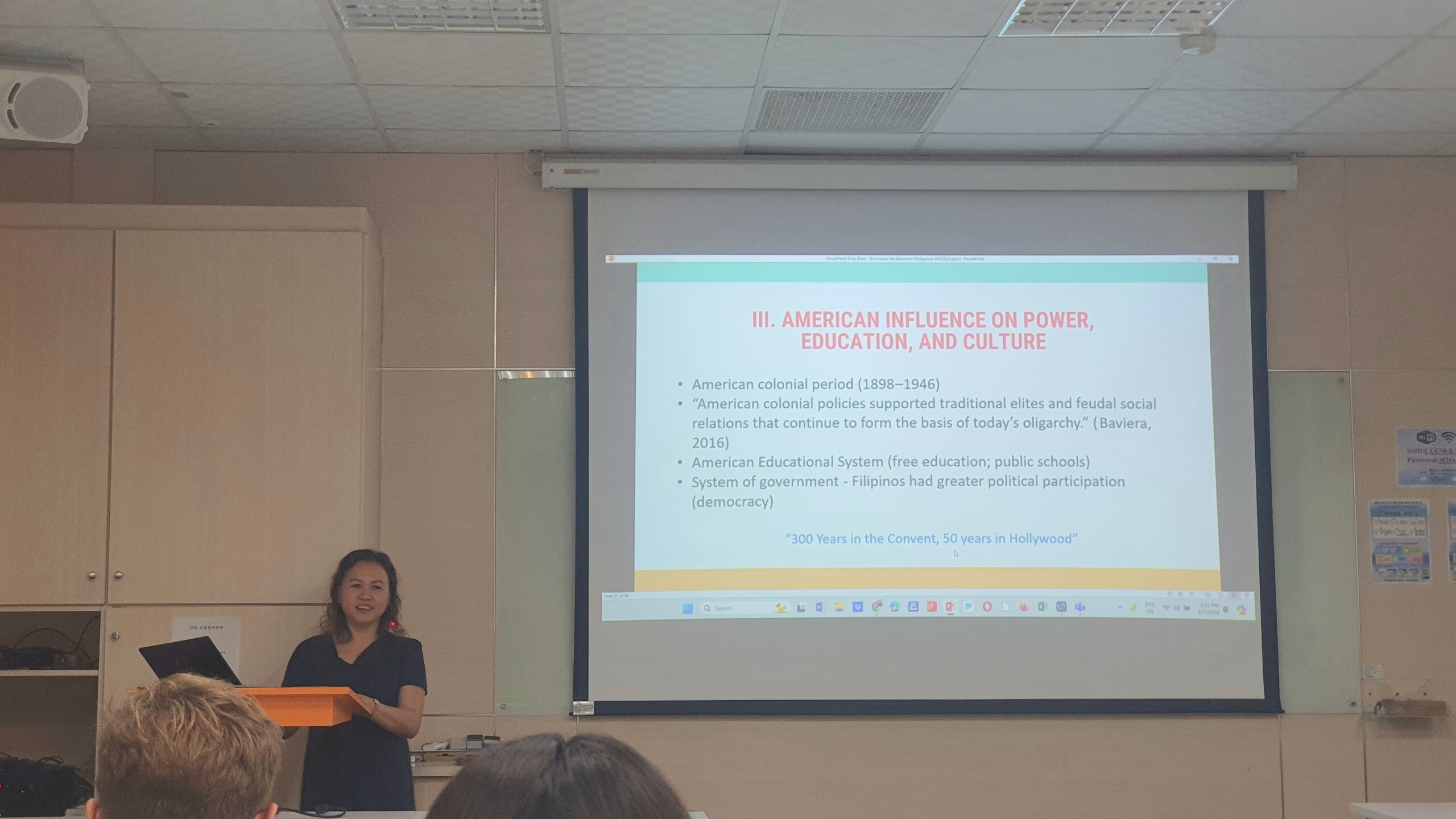
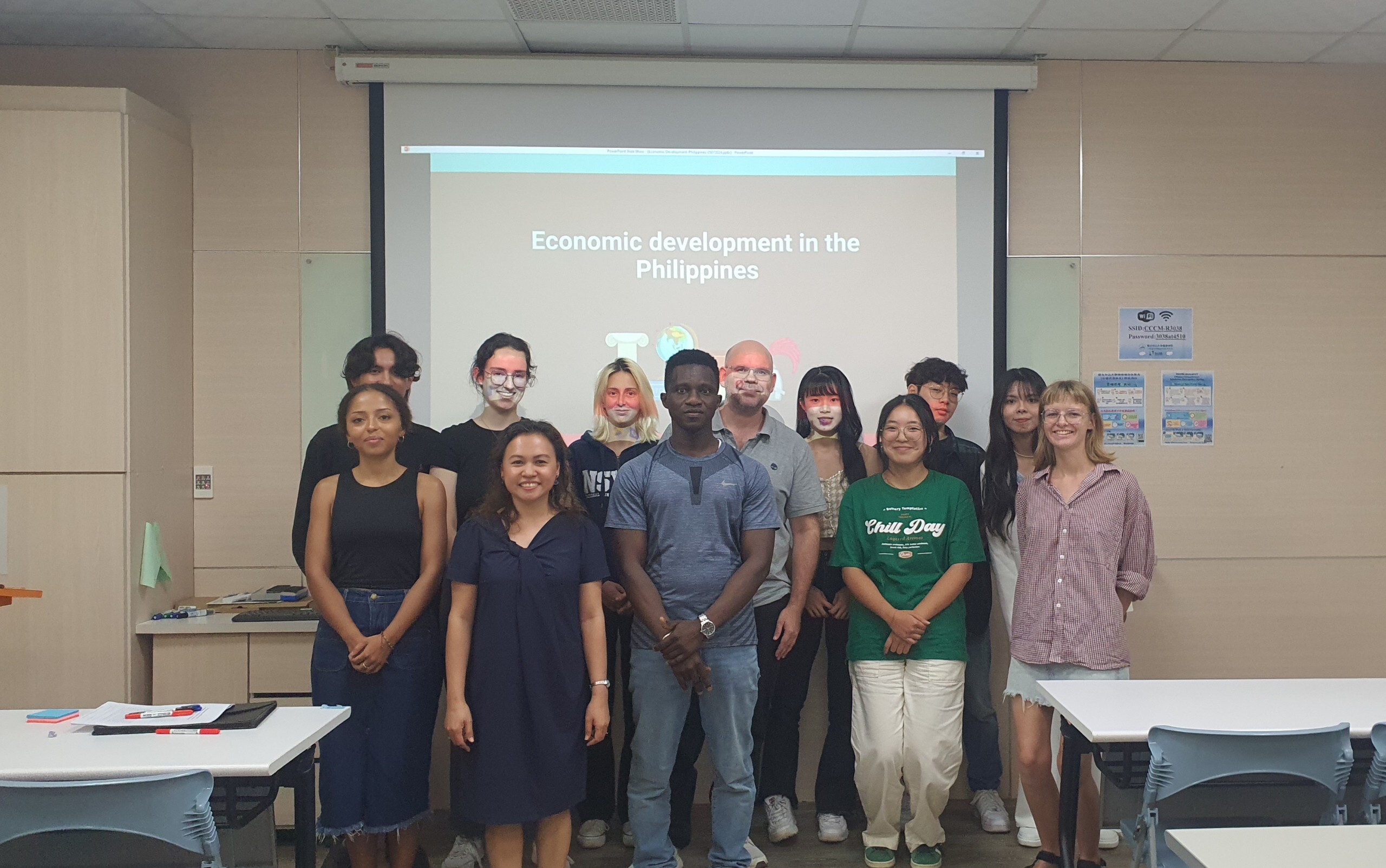
On May 7th, 2024, the ‘Asia Pacific Business Environment’ (IB528) course instructed by Dr. Ryan Brading, invited as a guest speaker, Dr. Elaine Borazon – from the International Graduate Program for Education and Human Development at NSYSU. In this course, conceptual terms such as economic development, capitalist models, neoliberal practices, institutional structures, trade accords, geopolitics, and so on – are discussed in order to provide the analytical frameworks to examine the countries from the Asia Pacific region. Dr. Borazon is originally from the Philippines and her research interests are in Entrepreneurship (SEM), Organizational Learning, and Food Environment.
In the previous lecture, which particularly focused on the Philippines, the lack of economic development and high levels of corrupt practices were very much discussed. It was noted that in the academic literature, the Philippines is referred to as “the sick man of Asia.” For this reason, compared with China and its neighbors in the region, the Philippines has been left behind. Another key element discussed is the current tensions this nation is experiencing with China in the South China Sea. This growing geopolitical conflict has triggered the Philippines to rekindle its historical defense alliances with Washington – shortly after consolidating Manila’s warm relations with Beijing during former President Rodrigo Duterte’s administration. This said, we discussed whether it would be better for the Philippines to get warmer with China – rather than the West. And, how can economic development be achieved in the Philippines during the next 30 years (2024-2054), and hopefully be recognized as the “healthy man of Asia”. Within these contexts, Dr. Ryan believed it was appropriate to invite Dr. Elaine Borazon to share with us in class her insight as a Filipino national on “Economic Development in the Philippines”.
Dr. Elaine’s sessions started with a fascinating introduction about the Philippines’ physical geography and culture. Surrounded by the West Philippine Sea, Sulu Sea and Celebes Sea in the South, and the Philippine Sea in the East, this country has 7,641 islands and three main regions, including Luzon, Visayas, and Mindanao. The capital of the Philippines is Manila, located in the National Capital Regions in Luzon. Following the general introduction of the Philippines, Dr. Elaine introduced the distribution of power in the Philippines. In this country, the power is equally divided among its three branches: Executive, Legislative, and Judicial. The Executive includes the President and the Vice President who were voted by direct popularity and has a six-year term. The second branch, Legislative, makes laws, changes, and repeals them through the power vested in the Philippine Congress. Judicial settle controversies including rights that are legally demandable and enforceable. Shortly after, expressed the historical impact of Spanish and American colonialism in the power structure of the Philippines, as well as educational and cultural practices. For example, toxic habits inherited from Spanish colonialism still trouble Philippine politics, such as a dysfunctional system of government, huge social disparities, massive corruption, etc.
Following that, Dr. Elaine pointed out the reasons why the Philippines is still poor. It is because of high population growth, high level of inequality between income and assets (crony elites), and natural disasters. However, she especially highlighted corruption, which is prevalent in the Philippines. Many years ago, Corpuz traced the historical roots of graft and corruption to the “ negative image” of government among Filipinos. Corrupt behavior takes place at three levels. The first one is Political Corruption. Government officials are the culprits. Abuse of official power by ruling parties is common. The second level is Patronage and State Capture. This phenomenon is so common that it doesn’t only obstruct the political system, but also affects other sectors such as health, the electoral process, etc. Furthermore, certain political elites and corporate backers ignore and spin electoral results. Petty or administrative corruption (or bureaucratic bodies) constitutes the third level. Dr. Elaine illustrated as an example the case of the former dictator Ferdinand Marcos’ Administration. Rampant corruption, abuse of power and massacre of opponents were common. Marcos and his family were accused of stealing between 5 to 10 billion US dollars of state assets. This regime was later ousted by the democrat Cory Acquino. Although promising radical changes, Aquino’s administration is also remembered for the amount of corruption scandals and political violence that carried on. The current President, Ferdinand “Bongbong” Marcos Jnr, son of the late dictator, admitted to employing a large group of people online, known as “troll army”, to support his campaign during the Presidential campaign. He confessed that he depended on this online group team to maintain his popularity support, especially when it was difficult to get positive coverage from traditional media outlets.
However, the Philippines has experienced significant effects from globalization – following the influence of the United States during World War II. Educational advancements have been promoted, and exports have contributed to GDP growth. Especially, thanks growth into the industrial sector, this country has become one of the highest per capita incomes in Southeast Asia. Nonetheless, many problems still exist during this period of globalization in the Philippines, such as lacking job opportunities, therefore putting more pressure on Filipino families from lower class. In the Philippines, multinational corporations have integrated into the economy. Recognizable brands in various sectors such as IKEA, Samsung, Apple, Grab, Nestle, etc. Among those, IKEA is considered as the key factor driving the Philippine Market forwards.
Overall, the guest speaker very much illustrated the current economic situation in the Philippines. Philippines ranks third out of sixth in GDP among Southeast Asian countries (Indonesia, Malaysia, Philippines, Singapore, Thailand and Vietnam). Nevertheless, the Philippines should address diverse challenges like high levels of inflation, increasing policy rates, the weakening of the Philippine peso against the US dollar, and the concerning increase of unemployment – in order to improve its productivity and economic growth.
In conclusion, Dr. Elaine gave such an overview and insightful presentation to the students. After listening to her views and rich illustrations, students learned a valuable lesson describing the dynamics of the economy in the Philippines, and its political obstacles. We believe this unique insight provided students an outlook of the cultural and institutional conditions of this Southeast Asian nation.