
Japan in Colour: Business by Day
Japan in Colour: Business by Day
May 7, 2016
The following article is part one of a two article series cataloging the IB612 Consulting trip to Japan from April 24 to 29.
DAY 1 - TOKYO, April 25, 2016: With clear skies, favorable weather, the atmosphere is ripe with anticipation. Today, students visit Professor Takeda from Hitotsubashi University in Tokyo. As students fill the university grounds, Professor Takeda Masahiko generously shares his economic knowledge and work experience at the International Monetary Fund (IMF).
Japan’s modern economic development may be defined by its developmental state model, which is further detailed by Chalmers Johnson in “MITI and the Japanese Miracle.” Unlike Taiwan, the economic history of Japan is largely defined by the lasting effects of her large conglomerate internetworks of the zaibatsu and keiretsu.
As the cliché is said, “the bigger they are, the harder they fall.” Japan is no exception. The revaluation of the yen through the Plaza Accord of 1985 initiated Japan’s housing collapse in 1990, and prolonged the lasting effects of the Asian Financial collapse of 1997.
Through austerity measures under Shinzo Abe, objectives are currently aimed under “three arrows”: stimulus, monetary reforms and structural reforms. Similar to Taiwan, Japan must also address how to manage its aging population, which compounds the challenges faced by Japan in securing its economic future. IB student, Julio León, describes Professor Takeda’s presentation as “highly interesting.”
In addition to Professor Takeda’s welcoming of IB612, two student groups from IB612 presented their mid-term presentations and consulting acumen before their audiences.
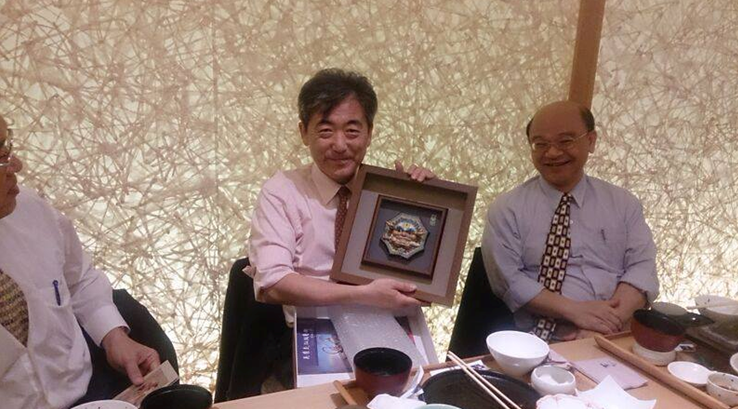
Professor Sung Chao-Hsien shares a moment with Professor Takeda
DAY 2 - TOKYO, April 26, 2016: Students arise at the crack of dawn. Despite the effects of jet lag visible in the facial expressions of IB612 students, they are adorned with their fanciest of business attire. Today’s destination: Yamato Transport Co. Ltd. The company has been specializing in logistics throughout Asia since the founding of the company in 1919.
The palpable crispness of the morning dew is invigorating, as students file from their temporary residence of the Richmond Hotel to their destination. Upon arrival at Haneda Chronogate headquarters, facilities appear to be unassuming from what one might expect from a global logistics facility. While outer premises are enshrouded with gardens and greenspace, inside facilities are reminiscent of a scene from an apocalyptic science fiction movie.
Red lasers fire in all directions amidst a mechanized labyrinth of conveyor belts, as they send packages in all directions. Most impressive is the precision of the conveyor belts in ensuring every package arrives at its corresponding destination node. A difference of a microsecond would plunge the operation into chaos, yet the meticulous accuracy of the working machinery performs like a seasoned orchestra.
The ubiquitous Yamato Transport Co. logo, which features two black cats, will forever be remembered in students’ memories as emblematic of the work ethic of the company behind it.
Next stop: Lintec. Students await at the Tokyo metro ad are greeted warmly by Lintec staff who cordially invite IB516 into their company facilities.
The company boasts 4,000 employees and operates in 15 countries including the United States. Lintec also brandishes an impressive repertoire of items including soccer balls, semiconductors and LCD products for which their adhesives are used. This is further exemplified by a poster in the front foyer which illustrates the daily applications of their products through a single photograph.
The staff are particularly friendly and display a cunning sense of humor by offering students an opportunity to smell the wasabi scented products they had at their facilities. Interestingly, the use of wasabi in certain products serves as both a disinfectant and an allurement for customers longing for the rich aroma of Japan. Lintec exhibits the characteristic hallmarks of Japanese efficiency.
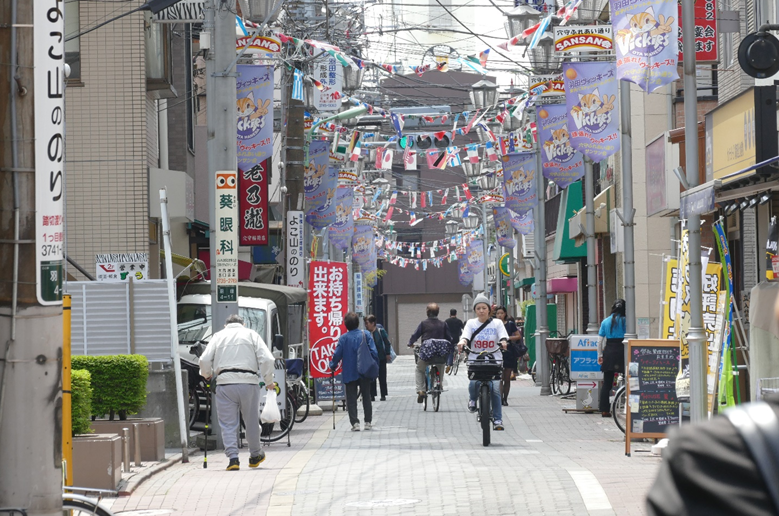
IB612 takes a brisk morning walk on the way to the Chronogate facilities in Haneda.
DAY 3 - TOKYO, April 27, 2016: 10:30 departure: The perfect opportunity to have Family Mart avocados for breakfast before a class visit to Mitsui & Co. Ltd. Similar to Lintec, Mitsui & Co champions its versatility across multiple sectors including aviation. salmon farming, and the upstream to downstream ends of oil production.
Students take their seats in the conference room at Mitsui & Co. Ltd. where one cannot deny the unmistakable heir of professionalism exuded by a company which claims $101.7 billion USD in total assets.
Company personnel welcome IB612 in their midst with warm speech on the significance of Dr. Sun Yat-sen, and his contributions to both the nation of Taiwan and NSYSU.
While Mitsui & Co. personnel cover a broad range of its bases, staff emphasise the company’s involvement in U.S. shale. Shale production emerged in the United States as a response to the OPEC cartel’s leverage of its supply to injure oil production in western markets which have incurred drastic losses since 2014.
In lieu of the devaluation of oil commodities prices, Mitsui & Co. maintains a steadfast commitment to their employees by shuffling personnel through their various channels and operations; a testament to the company’s agility and capacity through its 13 headquarters
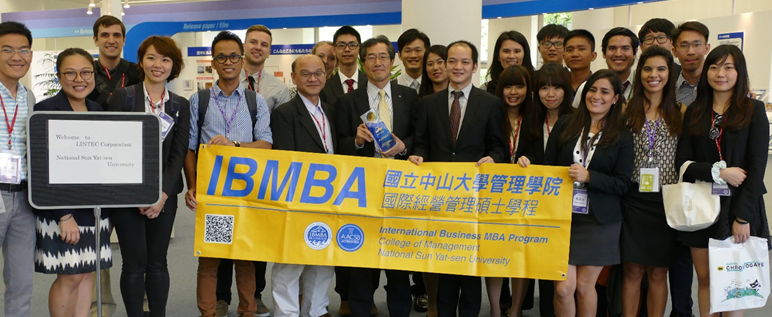
IB612 strikes a pose with friends from Lintec
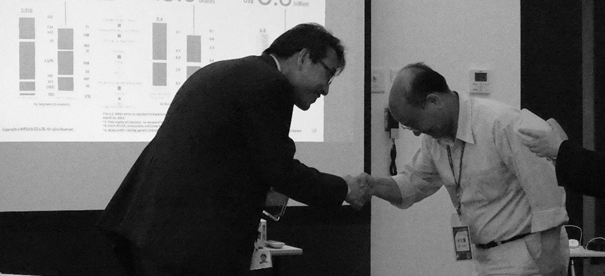
Professor Sung and Mitsui personnel welcome each other by practicing o-jigi, the honorific tradition of bowing in Japan
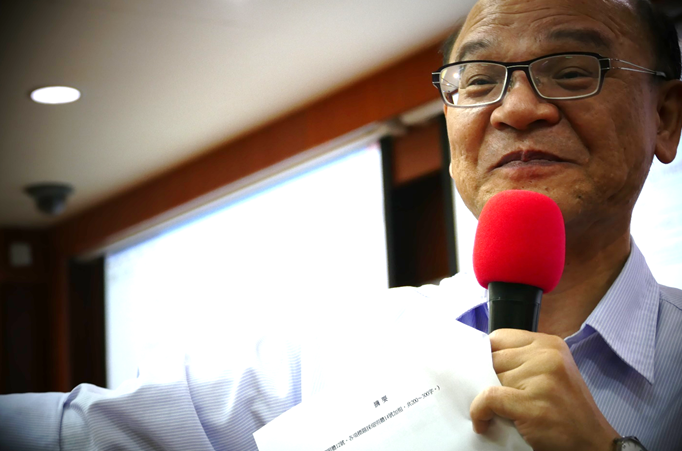
IB612 Professor, Sung Chao-Hsien looks onward with glee as he prepares students for Japan.
At last, a special word of thanks is due for Professor Sung. The extent of his efforts to ensure the success of his IB612 class trip to Japan has yielded students with bonding experiences and memories that will last for years to come. Brooke Daye, a former NSYSU student, once posited that “Professor Sung opens doors for people.” Indeed, beyond the doors of the conventional classroom, Professor Sung enabled IB612 students to enrich themselves in the Japanese pantheon of culture, beauty, art and a wider reality of existence.
Thank you, Professor Sung.
by Paul Squires